
Why South Korea & Taiwan Markets Are Falling — And Why FIIs May Return To India
Global investors are reassessing Asian markets as South Korea and Taiwan face growing pressure from weakening technology sentiment and geopolitical uncertainty. In this blog, we explore why foreign institutional investors may increasingly shift focus toward India and which sectors could benefit most from this capital rotation.
FINANCE
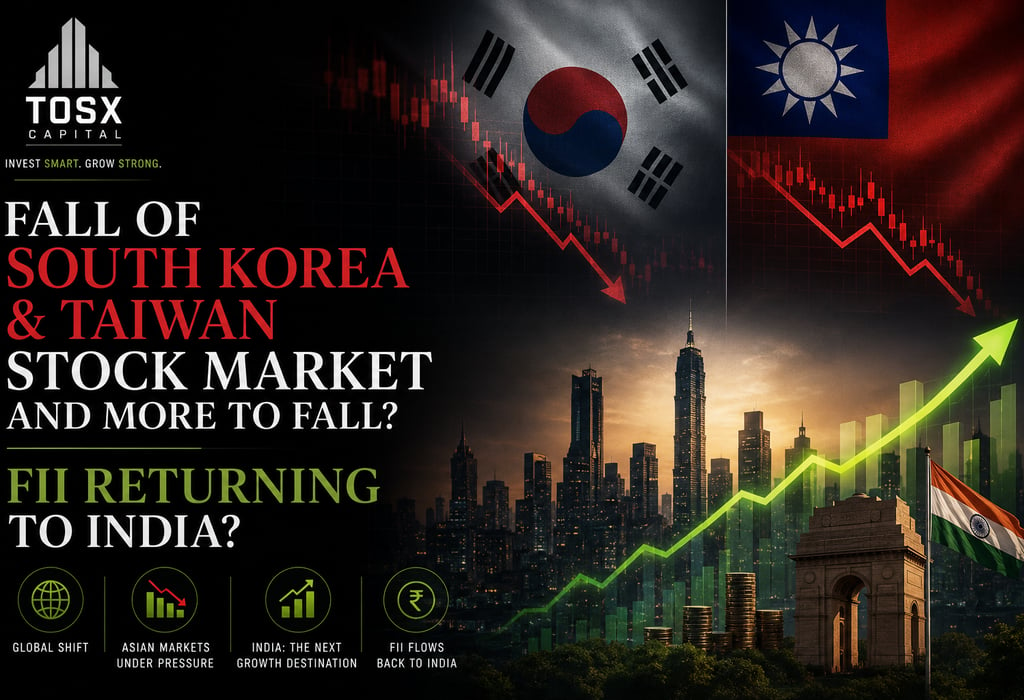
Why South Korea & Taiwan Markets Are Falling — And Why FIIs May Return To India
Asian markets are entering a phase of growing uncertainty.
Over the past few months, stock markets in South Korea and Taiwan — two of Asia’s strongest technology-driven economies — have witnessed rising volatility, weakening investor sentiment, and increasing foreign capital outflows.
Now, global investors are beginning to ask an important question:
Is India becoming the next major destination for foreign institutional money?
And if global uncertainty continues, the answer may increasingly be yes.
Why Are South Korean & Taiwan Markets Falling?
Both Taiwan and South Korea are deeply linked to the global technology and semiconductor industry.
Companies involved in:
chips
AI hardware
exports
electronics manufacturing
have experienced extraordinary rallies over the past year due to the artificial intelligence boom.
But markets rarely move in a straight line.
Today, several concerns are beginning to pressure these economies:
1. Overdependence On The Semiconductor Cycle
Taiwan and South Korea heavily depend on semiconductor exports.
Any slowdown in:
AI demand
global electronics consumption
US technology spending
can quickly impact market sentiment.
Investors are increasingly worried that parts of the technology sector may be overheating after aggressive rallies.
2. Geopolitical Risks Are Rising
Taiwan continues to face growing geopolitical tensions involving China and the broader US-China strategic conflict.
South Korea also remains exposed to:
regional security risks
export dependency
currency pressure
Global investors dislike uncertainty.
And when uncertainty rises, institutional capital often moves toward relatively stable and diversified markets.
3. Foreign Investors Are Booking Profits
After massive rallies in semiconductor and AI-linked stocks, many foreign funds are now:
reducing exposure
locking profits
reallocating capital
This has increased selling pressure in several Asian technology-heavy markets.
Why India Could Benefit
While many Asian markets are facing concentration risks, India currently offers something global investors are actively searching for:
Diversified growth.
India is not dependent on one single sector.
Instead, foreign investors see opportunities across:
banking
infrastructure
manufacturing
defence
digital economy
renewable energy
consumption growth
This makes India structurally more attractive during periods of global uncertainty.
FIIs May Return To India
Foreign Institutional Investors (FIIs) had previously reduced exposure to Indian equities due to:
elevated valuations
global interest rate uncertainty
shifting liquidity conditions
But conditions may now slowly begin to change.
As volatility rises in other Asian markets, India may increasingly appear as:
a relatively stable economy
a high-growth domestic consumption story
a long-term structural investment destination
Global funds are constantly rotating capital.
And in times of uncertainty, money often moves toward markets showing:
political stability
economic resilience
long-term growth visibility
India currently checks many of those boxes.
Sectors That Could Benefit
If FII flows strengthen again, sectors that may attract attention include:
Banking & Financials
Strong credit growth and rising retail participation continue to support Indian financial institutions.
Infrastructure
Government spending and long-term development projects remain major growth drivers.
Capital Markets & Asset Management
Rising investor participation and increasing SIP inflows continue strengthening India’s investment ecosystem.
Manufacturing & Defence
Global supply chain diversification is helping India emerge as an alternative manufacturing hub.
But Risks Still Exist
Investors should also understand that global risks remain significant.
Factors such as:
US interest rate policy
global recession fears
oil price volatility
geopolitical conflicts
can still create short-term pressure across world markets — including India.
Markets may remain volatile.
But long-term structural trends continue favoring disciplined investing approaches.
The Bigger Picture
The current weakness in Taiwan and South Korea may not simply be a temporary correction.
It may represent a broader shift in how global capital is positioning itself for the next economic cycle.
And in that transition, India could emerge as one of the most important long-term destinations for global institutional money.
For long-term investors, this period may become less about chasing hype — and more about identifying structural growth opportunities.
Because wealth is often built during phases of uncertainty, not excitement.
Disclaimer: This article is for educational and informational purposes only and should not be considered investment advice. Investors should conduct their own research or consult financial professionals before making investment decisions.
— TOSX Capital

Join t building the future via mutual fund
Start using AI-powered tools that elevate your trading and decision-making.