

UAE Nuclear Plant Attack: Why Global Markets Are Suddenly On Edge
The UAE nuclear plant attack has triggered concerns around oil prices, geopolitical instability, and global market volatility. Explore how the incident could impact financial markets, investor sentiment, gold prices, and global economies.
FINANCE
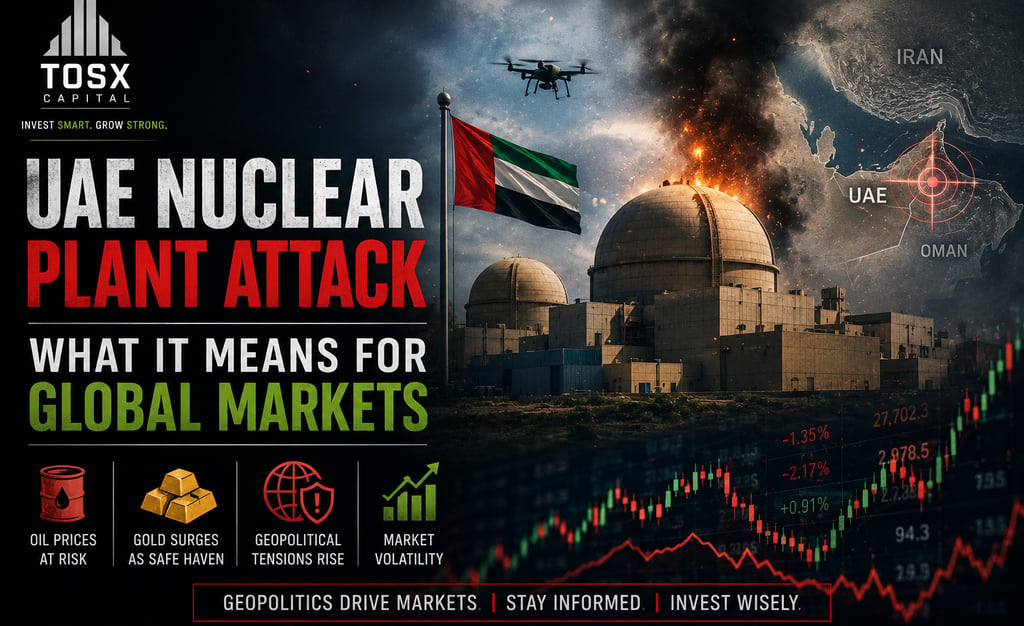
UAE Nuclear Plant Attack Sends Shockwaves Through Global Markets
Global markets were shaken after reports emerged of a drone strike near the Barakah Nuclear Power Plant in the United Arab Emirates (UAE), one of the Middle East’s most strategically important energy assets.
While UAE authorities confirmed that radiation levels remained normal and the facility continued operating safely, the attack has intensified fears surrounding geopolitical instability in the Gulf region — a region critical to global energy supply chains and financial markets. (Reuters)
The incident may prove to be more than just a regional security event.
For investors worldwide, it raises a larger question:
Is the world entering a new era of geopolitical market volatility?
What Happened At The Barakah Nuclear Plant?
According to UAE officials, a drone strike caused a fire in an external electrical generator near the Barakah Nuclear Power Plant, located in Abu Dhabi’s Al Dhafra region. Authorities stated that:
no radiation leak occurred
plant operations remained stable
no casualties were reported
The International Atomic Energy Agency (IAEA) also confirmed that it was monitoring the situation closely. (Reuters)
No group immediately claimed responsibility for the attack.
However, the strike comes amid escalating tensions involving Iran, Gulf nations, the United States, and Israel — creating serious concerns over the security of critical infrastructure across the Middle East.
Why This Matters To Global Markets
The Gulf region is not just geopolitically important.
It is:
one of the world’s largest energy corridors
central to oil exports
critical for global shipping routes
deeply linked to inflation and energy prices
Any escalation involving:
nuclear infrastructure
oil facilities
shipping routes
strategic energy assets
can rapidly affect global financial markets.
Markets dislike uncertainty.
And nuclear-related incidents create immediate fear-driven reactions across:
oil markets
equity markets
commodities
currencies
safe-haven assets like gold
Oil Markets Could Become Highly Volatile
The Barakah incident has again highlighted the vulnerability of Gulf energy infrastructure.
Investors are increasingly concerned that continued regional conflict could impact:
oil production
refining capacity
shipping movement through the Strait of Hormuz
The Strait of Hormuz remains one of the most important oil transit chokepoints globally.
Even the possibility of disruptions can create:
higher crude oil prices
inflation fears
increased transportation costs
pressure on global economies
Safe Haven Assets May Benefit
Historically, during periods of geopolitical instability, investors tend to move toward:
gold
defensive sectors
U.S. treasury assets
stable currencies
Gold prices often react strongly whenever global uncertainty rises.
This is because investors seek protection against:
inflation
war risks
economic instability
currency volatility
India’s Position In The Middle Of Global Uncertainty
India remains highly dependent on imported energy.
Any sustained rise in crude oil prices could:
increase inflation pressure
weaken the rupee
impact fiscal stability
create short-term market volatility
However, India also continues attracting long-term institutional capital because of:
strong domestic growth
rising retail participation
infrastructure expansion
digital economy growth
If global capital begins rotating away from unstable regions, India may continue benefiting as a long-term structural growth story.
The Bigger Concern: Critical Infrastructure Warfare
One of the most alarming developments globally is the growing targeting of:
energy facilities
nuclear infrastructure
data centers
logistics networks
Modern geopolitical conflicts are increasingly focused on disrupting economic systems instead of traditional battlefield warfare.
This creates:
long-term market uncertainty
higher global risk premiums
unpredictable commodity movements
Investors may need to prepare for an environment where geopolitical shocks become more frequent.
What Investors Should Focus On
Periods of fear often create emotional market reactions.
But long-term investors should focus on:
disciplined investing
diversification
risk management
long-term asset allocation
Market volatility is temporary.
Structural wealth creation is built through consistency and patience.
Final Thoughts
The UAE nuclear plant attack may become another reminder that global markets are now deeply connected to geopolitical stability.
Whether it impacts:
oil prices
investor sentiment
global equities
safe-haven assets
the event reinforces one reality:
Markets no longer move only on economics.
They increasingly move on geopolitics.
And in this environment, disciplined investing becomes more important than ever.
Disclaimer: This article is for educational and informational purposes only and should not be considered investment advice. Investors should conduct their own research before making investment decisions.
— TOSX Capital

Join thousands building the future via mutual funds
A disciplined SIP investment strategy allows individuals to participate in long-term market growth while investing manageable amounts regularly